








Automated soil profile classification under WRB 2022 (4th ed.), USDA Soil Taxonomy (13th ed.), and the Brazilian SiBCS (5th ed.). All three systems wired end-to-end, down to the deepest categorical level, in pure R driven from versioned YAML rules. Multimodal extraction, spatial priors, OSSL spectroscopy, and explicit per-attribute provenance — without ever delegating the taxonomic key to a language model.
▶ Try it live — no install: soilkeypro.com · on CRAN
(install.packages("soilKey")) · development on
GitHub.
| Domain | Stage | Notes |
|---|---|---|
| WRB 2022 — diagnostic horizons | ✅ shipped (40 / 40) | All 40 horizons of Chapter 3.1; audited by
coverage_report("wrb_horizons") against the canonical set,
with per-diagnostic tests plus a whole-set contract test. |
| WRB 2022 — diagnostic properties | ✅ shipped (17 / 17) | All 17 properties of Chapter 3.2; audited by
coverage_report("wrb_properties"). |
| WRB 2022 — diagnostic materials | ✅ shipped (19 / 19) | All 19 materials of Chapter 3.3; audited by
coverage_report("wrb_materials"). |
| WRB 2022 — RSG key | ✅ shipped (32 / 32) | All Reference Soil Groups in canonical Chapter 4 order; audited by
coverage_report("wrb_rsg"). |
| WRB 2022 — qualifiers | ✅ shipped (233/234) | 233 of 234 canonical qualifiers deliverable (224 implemented + 9
specifier-derived); 1 honest gap (Novic, schema-blocked).
coverage_report("wrb_qualifiers") counts genuine
implementations only, following one level of delegation. |
| SiBCS 5 — Order | ✅ shipped (13 / 13) | All 13 SiBCS Orders. |
| SiBCS 5 — Suborder | ✅ shipped (44 / 44) | All 44 Suborders. |
| SiBCS 5 — Great Group | ✅ shipped (192 / 192) | All 192 Great Groups. |
| SiBCS 5 — Subgroup | ✅ shipped (938 / 938) | All 938 Subgroups; full leaf-level resolution. |
| SiBCS 5 — Family (5th level) | ✅ shipped | Up to 15 orthogonal adjectival dimensions. |
| USDA Soil Taxonomy 13 — Path C | ✅ shipped (v0.9.113) | Order → Suborder → Great Group → Subgroup (12 / 68 / 339 /
2049 of 2715 canonical subgroups, 75.5% — by-name
coverage_report(); +829 in v0.9.113, +57 colour/contact in
v0.9.121, +25 intergrades in v0.9.123). |
| USDA Soil Taxonomy 13 — Family | ✅ shipped (v0.9.104) | 5th-level family modifiers (particle-size, mineralogy, CEC-activity,
reaction, temperature, depth), prepended to the subgroup via
classify_usda(include_family = TRUE). Series (6th) needs
the NRCS database — out of scope. |
| Multimodal extraction (VLM) | ✅ shipped | Schema-validated via ellmer; the LLM never touches the
key. Local-first in the package (Ollama / any provider); the hosted app
uses an online provider (Groq). |
| OSSL spectral gap-fill | ✅ shipped | Vis-NIR / SWIR / MIR via prospectr +
resemble (MBL / PLSR-local / pretrained backbones). |
| Within-pedon gap-fill | ✅ shipped (v0.9.120) | gapfill_within_pedon() /
classify_*(gapfill = TRUE): interpolates interior
missing horizon values from the profile’s own measured layers (never
extrapolates). Opt-in, byte-identical when off, tagged
inferred_prior (grade C). |
| Spatial priors | ✅ shipped | SoilGrids WCS + national soil maps; consistency check, never overrides the key. |
| Provenance ledger | ✅ shipped | Per-attribute tags: measured,
predicted_spectra, extracted_vlm,
inferred_prior, user_assumed. |
| Evidence grade (A–E) | ✅ shipped | Computed from the trace; surfaces robustness without hiding it. Five-grade scale since v0.9.99. |
| Cross-system correlation | ✅ shipped | WRB ↔︎ USDA ↔︎ SiBCS via IUSS WRB 2022 Annex 6; full benchmark drivers. |
| External-data benchmarks | ✅ shipped (code) | KSSL+NASIS, AfSP, WoSIS stratified, BDsolos (RJ), Redape (Vaz et al. 2023), LUCAS 2018; the data come from each provider and are not bundled (provenance). |
| Reproducible benchmark suite | ✅ shipped (v0.9.106) | run_all_benchmarks() — one call auto-detects local
datasets, runs each (Redape now pooled into
benchmark_unified), and writes a consolidated report.
Latest (n≤200, order level): FEBR SiBCS 38%, BDsolos SiBCS 33%, KSSL
USDA 40%, LUCAS WRB 0% (honest topsoil baseline). |
| SiBCS accuracy uplift | ✅ shipped (v0.9.107) | Benchmark-guided recovery of four zero-recall SiBCS orders on the Redape gold standard (Gleissolos/Plintossolos/Vertissolos to full recall, Chernossolos partial), via Redape-scoped morphology-suffix promotion + a stacked chernic-A fix. Redape order accuracy 45.7% → 59.6% (+13 profiles); 44 canonical fixtures unchanged. |
| SmartSolos Expert API bridge | ✅ shipped | classify_via_smartsolos_api() cross-validates against
Embrapa’s authoritative reference. |
| Lazy-fetch benchmark caches | ✅ shipped (v0.9.94) | Four large .rds samples downloaded on demand from a
versioned GitHub Release. |
| CRAN release | ✅ on CRAN (0.9.184) | install.packages("soilKey") — CRAN, GitHub, and the
live app all at 0.9.184. |
| Live web app — soilkeypro.com | ✅ shipped | The Pro app in the browser, no install: soilkeypro.com (Google Cloud Run,
HTTPS, www → apex). |
| Online AI assistant | ✅ shipped | In-app assistant (Groq via ellmer) that
explains the deterministic result and reads Munsell from photos
— grounded in the key, never inventing a class. |
| R Shiny web app | ✅ shipped (v0.9.97) | run_classify_app() — nine-tab bslib
interface: interactive pedon builder, tri-system classify, VLM photo,
OSSL spectra, SoilGrids prior, interactive leaflet map, MC
uncertainty, HTML/PDF report. |
| Pro app polish | ✅ shipped (v0.9.108) | Soil-palette theme + www/soilkey.css, a global pedon
ribbon, a “Getting started” modal with a one-click Load example
& classify, Vis-NIR spectrum + photo previews, lat/lon
validation, USDA-family / WRB-specifier toggles in the Classify sidebar,
and a report() that honours both depth-level options
(additive, default-off). |
| Bilingual Pro app (i18n) | ✅ shipped (v0.9.114) | English + Brazilian Portuguese, dependency-free: a 352-string
catalogue (inst/i18n/translations.yaml) + an
i18n() helper + a navbar EN/PT selector;
run_classify_app(lang = "pt"). English is the default and
holds the strings verbatim, so the app is byte-identical by
default. |
| Accessible + responsive app | ✅ shipped (v0.9.115) | Document lang follows the UI language, navbar selector
aria-label, aria-live notifications, WCAG-AA
contrast, prefers-reduced-motion; CSS breakpoints
(768/480px) make the app usable down to a ~375px phone. Markup/CSS
only. |
| WRB Tier-3 RSG-gate strict mode | ✅ shipped (v0.9.98) | classify_wrb2022(strict = TRUE) strengthens seven RSG
gates (Vertisol clay 30→35 %, Chernozem BS 50→80 %, etc.);
backward-compatible. |
| Field-photo-only classification | ✅ shipped (v0.9.99) | classify_from_photos() — photo + GPS → VLM Munsell +
SoilGrids depth prior → multi-system classification; evidence grade D /
C, never A. |
| Pedometric uncertainty quantif. | ✅ shipped (v0.9.100) | classify_with_uncertainty() — provenance-weighted
Monte-Carlo posterior over classes; per-grade perturbation magnitudes (A
±3 % … E ±30 %), attribute sensitivity ranking. |
| Interactive map tab | ✅ shipped (v0.9.101) | New “Map” tab in the Pro app: click a leaflet map to
place a point and query the SoilGrids class prior there
(soil_classes_at_location()); buffer + class distribution +
typical attributes. Phase 1 of the mapping roadmap (point prior). |
| Batch soil map | ✅ shipped (v0.9.102) | “Batch classify” sub-tab: classify many profiles at once (demo fixtures or an uploaded long-format CSV) and map them by class (WRB / SiBCS / USDA), with a legend, per-point popups and GeoPackage export. Phase 2 of the mapping roadmap. |
| Gridded prediction (DSM) | ✅ shipped (v0.9.103) | “Grid prediction” sub-tab: a raster class map over a bbox via three methods — SoilGrids covariates run through the deterministic key, nearest-neighbour interpolation of classified points, or the SoilGrids MostProbable overlay — with a class summary and GeoTIFF export. Phase 3 completes the mapping roadmap. |
Legend: ✅ shipped · 🟡 in queue · 🔵 idea / roadmap
A canonical Brazilian Latossolo Vermelho on tropical gneiss, classified end-to-end across the three canonical systems down to the deepest level:
library(soilKey)

pedon <- make_ferralsol_canonical()

# WRB 2022 — full name (RSG + qualifiers, Chapters 4 and 2.2)
classify_wrb2022(pedon)$name
#> [1] "Geric Rhodic Ferralsol (Clayic, Epic, Eutric, Ferric, Humic)"

# SiBCS 5 — 4th level (Subgroup) + Family (5th level)
classify_sibcs(pedon, include_familia = TRUE)$name
#> [1] "Latossolos Vermelhos Distroficos tipicos, argilosa, moderado"

# USDA Soil Taxonomy 13 — Order -> Suborder -> Great Group -> Subgroup
classify_usda(pedon)$name
#> [1] "Rhodic Hapludox"classify_wrb2022(specifiers = TRUE)).include_family = TRUE).All three keys are deterministic R code driven from versioned YAML rules.
The whole pipeline, in the browser, no install
required: soilkeypro.com (or run it
locally with run_classify_app()). A bilingual (EN/PT)
bslib interface built straight on the package — the same
deterministic keys, nothing re-implemented.
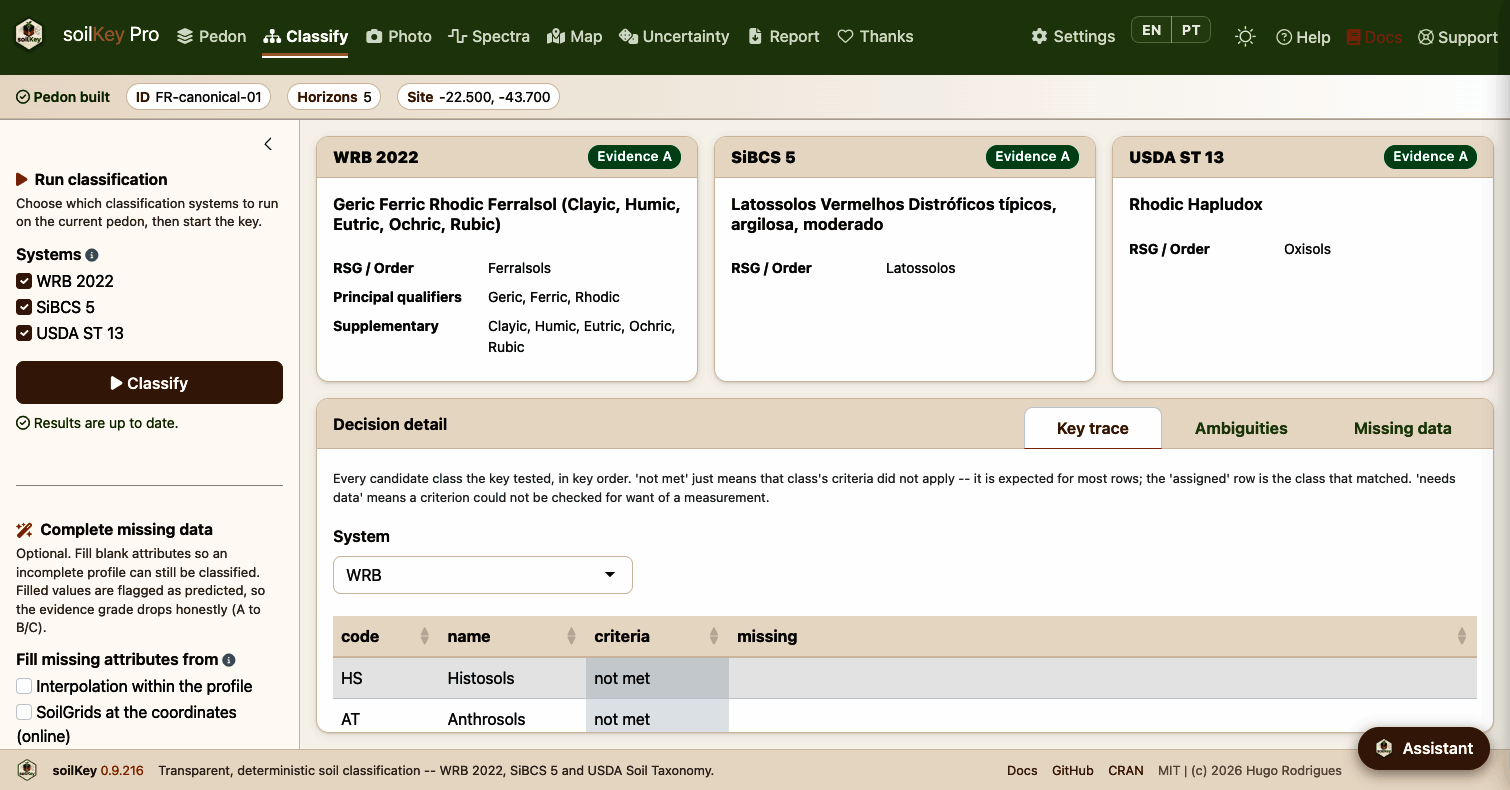
Classify — the three systems at once, each with its evidence
grade and the full decision trace.
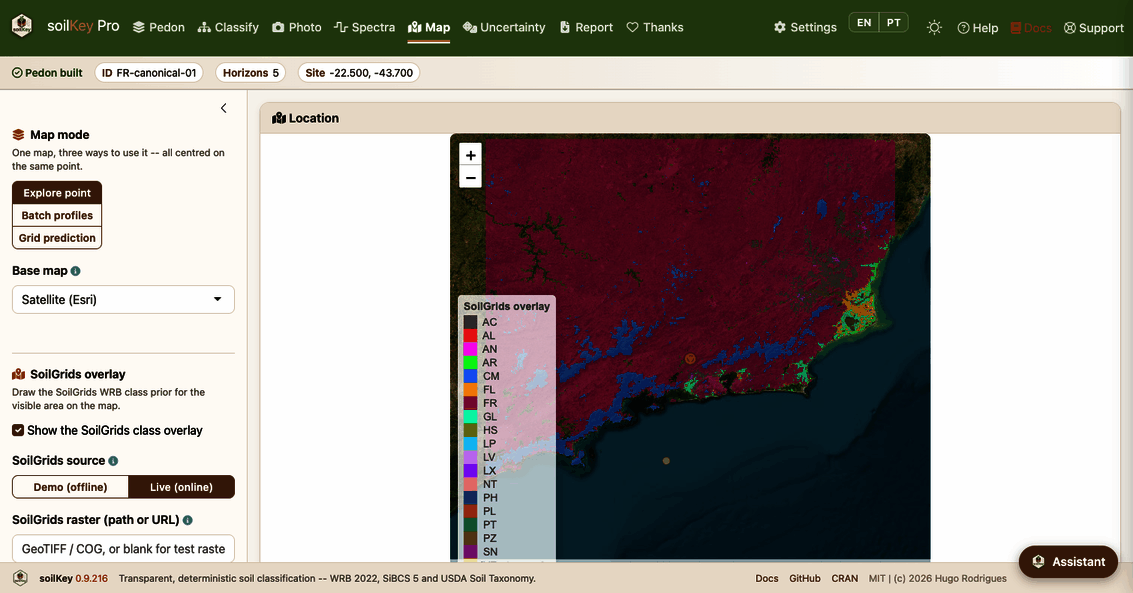
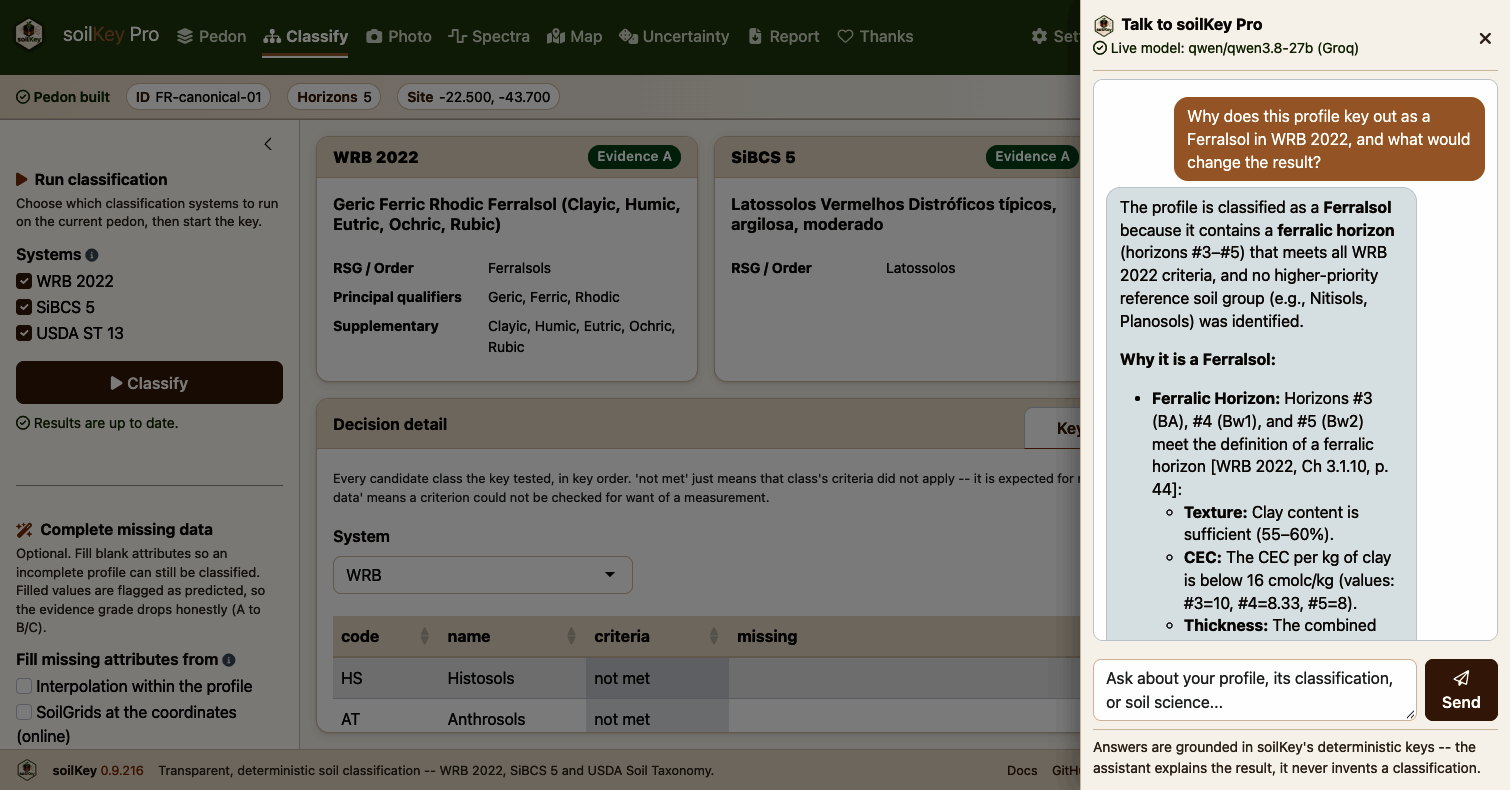
Map — the live SoilGrids classes around the site ·
Assistant — an online model that explains the result from
the key’s own evidence; it never classifies.
PedonRecord is filled, never the key.ellmer) that explains the deterministic result and
answers soil-science questions. It is grounded in the key trace and
never invents a classification.Hosting is a shared container image (deploy/) on Google
Cloud Run — HTTPS, www → apex, always-on.
soilKey reached CRAN and the Pro app went to production. Highlights
(full detail in NEWS.md):
install.packages("soilKey")
(0.9.184); CRAN, GitHub, and the live app are all in sync.munsellinterpol’s XYZtoMunsell(white=) with a
D65→Illuminant-C fix (thanks to Glenn Davis), a perfect-diffuser
Value = 10 test, and a neutral “N” hue at zero chroma.R CMD check was clean only because CI
didn’t pass --as-cran; under --as-cran, 545
exported topics lacked a \value section (a likely CRAN
rejection). The ~600 atomic taxonomic-engine predicates
(qual_*, *_usda gates, carater_*
/ horizonte_*) are now @keywords internal —
still exported and callable, but out of the public reference index,
trimming the documented API from ~910 to ~195 topics; the remaining ~85
public topics gained \value. The package now passes
R CMD check --as-cran with 0 errors / 0
warnings. Runnable \examples were added to the
entry points, CI now runs --as-cran +
pkgdown::check_pkgdown(), and the release metadata
(cran-comments, CITATION.cff, lifecycle → maturing) was
refreshed. No user-visible behaviour changed.run_classify_app(ui = "pro")) gets a thorough UX pass
— the last of the three follow-up fronts (benchmarks → accuracy → app).
A soil-science theme (topsoil-brown / terracotta / moss
palette over flatly, plus a slim
www/soilkey.css) and a navbar wordmark give it an identity;
a global pedon ribbon keeps the active profile (id,
horizons, coordinates, build status) visible on every tab; a
“Getting started” Help modal offers a one-click
Load example & classify that builds the canonical
Ferralsol through the real Pedon flow and jumps straight to the results.
The Spectra tab plots the attached Vis-NIR spectrum
(one trace per horizon) and the Photo tab previews the
uploaded image with the VLM confidence as an evidence badge. Coordinates
are range-validated before a pedon is built, the
USDA-family and WRB-depth-specifier
toggles are surfaced in the Classify sidebar (two-way-synced with
Settings), and the Report now honours both:
report(pedon, include_family = TRUE, specifiers = TRUE)
forwards the flags to the keys. The two new report()
arguments default to FALSE, so the output stays
byte-identical unless opted in. No new
dependencies.classify_wrb2022(pedon, specifiers = TRUE) auto-attaches
the WRB 2022 Chapter 5 depth specifiers
(Epi-/Endo-/Bathy-/Amphi-/Panto-/Kato-) to depth-anchored qualifiers,
computed from the diagnostic feature’s actual depth — e.g. a gleyic
feature confined to 50–100 cm becomes Endogleyic. The engine
existed since v0.9.2.B but only fired on already-prefixed names; this
wires in the automatic computation. Applied to subsurface qualifiers
only (epipedons like Mollic/Umbric are excluded — their depth is
definitional). Default specifiers = FALSE keeps the
canonical names byte-identical (verified across every
canonical fixture). Exposed on classify_all() and via a
Settings toggle in the Pro app.classify_usda(pedon, include_family = TRUE) prepends the
family modifiers to the subgroup, e.g. “fine, kaolinitic,
isohyperthermic Rhodic Hapludox”. Like the SiBCS
familia, the family is computed, not keyed
— six orthogonal dimensions (particle-size, mineralogy via
compute_ki/compute_kr, CEC-activity, reaction,
temperature regime, depth), each a FamilyAttribute carrying
its evidence and missing fields. The soil temperature regime uses
site$soil_temperature_regime when present, else infers it
from latitude/elevation (flagged as inferred).
classify_all(include_family = TRUE) and a Settings toggle
in the Pro app expose it. The default
(include_family = FALSE) is byte-identical to before. All
three systems now classify to their deepest formal level.The mapping roadmap, complete — the Pro Shiny app’s three cartographic surfaces.
leaflet surface where you click to place a point and query
the SoilGrids class prior at that location via
soil_classes_at_location(). The tab renders the queried
buffer, the ranked class distribution (WRB 2022 / USDA ST 13 / SiBCS 5),
and the canonical typical-attribute table — and it works with or
without a built pedon (a map click and a built pedon’s coordinate
stay in sync). This is Phase 1 of the mapping roadmap.
Adds leaflet to Suggests.PedonRecord each).
Every profile runs through classify_all(); points are drawn
on a leaflet map coloured by reference soil group / order
with a legend and per-point popups, listed in a summary table, and
exportable to a GeoPackage via sf. This is Phase
2 — the genuine pedon-scale soil map, each point backed by a
deterministic classification.terra). This is Phase 3 —
completing the mapping roadmap. Per §14 of ARCHITECTURE.md,
the covariate method is framed as complementary to, not a
replacement for, pixel-scale DSM.Four sequential roadmap releases that turn every previously pending README item into shipped functionality.
run_classify_app() launches an eight-tab bslib
interface: interactive pedon builder (44 canonical fixtures, editable
horizon table, live plotly depth profile), tri-system
classification with the full key trace, VLM photo extraction, OSSL
spectral gap-fill, SoilGrids spatial prior, Monte-Carlo uncertainty, and
a downloadable HTML / PDF report. The interface is bilingual (English /
Portuguese) and the report follows the chosen language. The legacy
single-page “classic” uploader was retired in v0.9.117
(ui = "classic" now warns and launches the Pro app).classify_wrb2022(strict = TRUE) strengthens seven Tier-2
RSG gates (Vertisols / Andosols / Gleysols / Planosols / Ferralsols /
Chernozems / Kastanozems) toward the canonical WRB 2022 Chapter 4 intent
— e.g. the Vertisol overlying-clay floor rises 30 → 35 %, the Chernozem
base-saturation floor 50 → 80 %. strict = FALSE (the
default) is byte-identical to v0.9.97; every canonical fixture
classifies the same under both modes.classify_from_photos() assembles a PedonRecord entirely
from VLM extraction of field photographs (Munsell colour per horizon +
optional site metadata), back-fills missing attributes from a SoilGrids
depth prior, and runs all three keys. Companion exports
apply_soilgrids_depth_prior() (depth-resolved companion to
spatial_prior_soilgrids()) and
compute_per_attribute_evidence_grade() (per-cell A–E
breakdown). Evidence grade E (user-assumed) was split
out from D so a wholly assumed value is distinguishable from a
VLM-extracted one.classify_with_uncertainty() returns a probabilistic class
distribution from a Monte-Carlo perturbation of the provenance ledger —
each (horizon, attribute) cell is perturbed by an amount
scaled to its evidence grade (A measured ±3 %, B spectra ±7 %, C prior
±10 %, D VLM ±17 %, E assumed ±30 %). The result is a
soilkey_uncertainty object: posterior
P(class), Shannon entropy, and a leave-one-attribute-out
sensitivity ranking that answers “what should I measure next?”.
classification_robustness(provenance_aware = TRUE) exposes
the same weighting on the v0.9.42 API.The v0.9.81 → v0.9.96 release series ships 17 surgical
fixes across the WRB 2022, SiBCS 5, and USDA Soil Taxonomy 13
keys, plus a CRAN-readiness polish pass. Default canonical behaviour is
bit-for-bit preserved in every release; one option
(soilKey.diagnostic_engine = "aqp") auto-bundles the
data-quality-aware paths.
Cumulative empirical lift on five external datasets (post-v0.9.95):
| Dataset | n | Default | engine = "aqp" |
Lift |
|---|---|---|---|---|
| SiBCS BDsolos RJ | 722 | 40.3% | 46.6% | +6.3pp |
| SiBCS Redape Order | 94 | 45.7% | 58.5% | +12.8pp |
| WRB KSSL+NASIS | 99 | 21.2% | 24.2% | +3.0pp |
| WRB AfSP | 120 | 21.7% | 30.8% | +9.1pp |
| WRB LUCAS Stage 3 | 30 | 0.0% | 60.0% | +60.0pp |
Plus the v0.9.81 honest 4-level Redape benchmark: Suborder 30.9% → 39.4%, Great Group 29.1% → 35.2%, Subgroup 15.1% → 25.0%.
Highlights of the release series (full per-release diff in NEWS.md):
benchmark_redape() now
actually computes Suborder / Great Group / Subgroup accuracy.spodic() engine-aware
OC-translocation path: KSSL+NASIS Spodosols 1/14 →
5/14.andosol() buried-exclusion +
andic OC+BD proxy thickness extension. AfSP Andosols 0/5 →
2/5.engine="aqp" auto-bundles the v0.9.69 ECEC fallback, the
v0.9.70 texture-morphological fallback, and the v0.9.90 argic
designation-inference fallback. BDsolos RJ Latossolos 14.9% →
28.1%, Order 40.3% → 46.6%.[[reference_wrb]]
access on the bundled WoSIS / KSSL / KSSL+NASIS caches (sidesteps R’s
$-partial-matching footgun). Those caches were removed in
v0.9.199.R CMD check --as-cran, lazy-fetch architecture brings the
source tarball from 10 MB to 6 MB.There is no public, maintained, end-to-end implementation of any of
the three major soil classification systems. WRB acknowledges (in the
4th-edition preface) that internal classification algorithms exist
within the IUSS Working Group but have not been released. The U.S.
SoilTaxonomy package on CRAN provides lookup tables but not
the key. There is zero public software for SiBCS in any
language — until soilKey.
soilKey closes that gap with three principles:
measured · predicted_spectra ·
extracted_vlm · inferred_prior ·
user_assumed. The result’s evidence grade (A–E)
summarises that log so callers always know how robust the classification
is.flowchart TB
subgraph M2["Module 2 — Multimodal extraction"]
A[PDF · Field report] --> V(VLM via ellmer)
B[Profile photo] --> V
C[Field sheet] --> V
V --> J["JSON-Schema<br/>validation + retry"]
end
subgraph M4["Module 4 — Spectra"]
K[Vis-NIR / SWIR / MIR] --> O("OSSL prediction<br/>MBL · PLSR-local · pretrained")
O --> P["PI95 → confidence"]
end
subgraph M3["Module 3 — Spatial prior"]
S[SoilGrids WCS] --> R(("P(RSG)"))
EM[National soil map] --> R
end
J --> PR["PedonRecord<br/>(provenance log)"]
P --> PR
PR --> M1["Module 1 — Taxonomic keys"]
M1 --> W["WRB 2022 key<br/>32 RSGs · Ch 4–6 (qualifiers + specifiers)"]
M1 --> SC["SiBCS 5 key<br/>13 Orders · 44 Suborders · 192 GG · 938 SG · Family"]
M1 --> U["USDA ST 13<br/>12 Orders · 68 Suborders · 339 GG · 1288 SG"]
W --> CR["ClassificationResult<br/>name · trace · evidence grade"]
SC --> CR
U --> CR
R -.consistency check.-> CRModule 1 (the key) and the side modules (extraction / spectra / spatial) are independent. A profile with no spectra still classifies; a profile with full lab data still benefits from the spatial-prior consistency check.
soilKey faithfully reproduces three canonical books, with versioned YAML rules cross-referencing the page numbers of each diagnostic and qualifier definition.
| Chapter | Component | Coverage |
|---|---|---|
| Ch 3.1 | Diagnostic horizons | 40 / 40 |
| Ch 3.2 | Diagnostic properties | 17 / 17 |
| Ch 3.3 | Diagnostic materials | 19 / 19 |
| Ch 4 | Reference Soil Groups (RSGs) | 32 / 32 |
| Ch 6 | Principal + supplementary qualifiers | all wired |
| Level | Coverage |
|---|---|
| 1st level — Order | 13 / 13 |
| 2nd level — Suborder | 44 / 44 |
| 3rd level — Great Group | 192 / 192 |
| 4th level — Subgroup | 938 / 938 |
| 5th level — Family | all wired (up to 15 orthogonal adjectival dimensions) |
| Level | Coverage |
|---|---|
| Order | 12 / 12 |
| Suborder | 68 / 68 |
| Great Group | 339 / 339 |
| Subgroup | 2049 / 2715 (75.5%,
by-name coverage_report("usda_subgroup")) |
# install.packages("remotes")
remotes::install_github("HugoMachadoRodrigues/soilKey")

# Or via devtools
# install.packages("devtools")
devtools::install_github("HugoMachadoRodrigues/soilKey")
Optional benchmark caches (4 datasets × ~1 MB each) are downloaded on
demand on first call to any load_*_sample() function. To
prefetch them all into the user cache:
soilKey::download_extdata_cache("all")PedonRecord from horizon datalibrary(soilKey)
hz <- data.table::data.table(
top_cm = c(0, 20, 55, 115),
bottom_cm = c(20, 55, 115, 200),
designation = c("Ap", "AB", "Bw1", "Bw2"),
munsell_hue_moist = c("10YR","7.5YR","2.5YR","2.5YR"),
munsell_value_moist = c(4, 4, 3, 3),
munsell_chroma_moist = c(3, 5, 6, 6),
clay_pct = c(35, 45, 65, 65),
sand_pct = c(25, 20, 15, 15),
silt_pct = c(40, 35, 20, 20),
cec_cmolc_kg = c(8, 6, 5, 4),
bs_pct = c(35, 30, 25, 20),
oc_pct = c(2.0, 1.0, 0.5, 0.3),
ph_h2o = c(5.0, 5.2, 5.3, 5.4),
bulk_density_g_cm3 = c(1.0, 1.1, 1.2, 1.2)
)
hz <- ensure_horizon_schema(hz)
pedon <- PedonRecord$new(
site = list(id = "demo-001", lat = -22.4, lon = -43.7, country = "BR"),
horizons = hz
)# WRB 2022 — full name
classify_wrb2022(pedon)$name
# SiBCS 5 — 4th level (Subgroup) + 5th level (Family)
classify_sibcs(pedon, include_familia = TRUE)$name
# USDA Soil Taxonomy 13 — Subgroup
classify_usda(pedon)$nameres <- classify_wrb2022(pedon)
res$evidence_grade # one of "A", "B", "C", "D"
res$trace # full decision walk: which RSGs were tested, why each failed/passed
res$missing_data # attributes the key wanted but couldn't find
res$ambiguities # alternative classifications still viable on the data# Vis-NIR spectrum per horizon, OSSL backbone:
pr <- predict_horizon_attributes(
pedon,
spectra = list(Ap = vnir_ap, Bw1 = vnir_bw1, Bw2 = vnir_bw2),
models = c("clay_pct", "oc_pct", "cec_cmolc_kg"),
ossl_engine = "PLSR-local"
)
# Each filled attribute carries provenance = "predicted_spectra" + PI95 confidence.
# Now classify_wrb2022(pr)$evidence_grade may be "B" (predicted_spectra)
# instead of "A" (measured) — provenance survives.# SoilGrids 250 m WCS at the site coordinates:
prior <- spatial_prior(pedon, source = "soilgrids")
res <- classify_wrb2022(pedon, prior = prior)
res$prior_check
# If the assigned RSG is inconsistent with the SoilGrids posterior,
# `res$warnings` flags it. The prior never overrides the key.# All three results in a single one-pager (HTML, no external deps):
classify_all_to_html(pedon, output_file = "demo-001.html")
# Or pass an explicit list of results:
classify_all_to_html(
list(
wrb = classify_wrb2022(pedon),
sibcs = classify_sibcs(pedon),
usda = classify_usda(pedon)
),
output_file = "demo-001.html"
)
# PDF (requires rmarkdown + LaTeX):
classify_all_to_pdf(pedon, output_file = "demo-001.pdf")soilKey ships eleven benchmark drivers under
inst/benchmarks/. The post-v0.9.95 cumulative sweep on five
external datasets (reproduced from a clean session by
inst/benchmarks/run_v0987_post_086_sweep.R in ~30 seconds,
plus the LUCAS Stage 3 SoilGrids fill at ~60 minutes from the v0.9.82
RDS):
26 hand-built canonical fixtures (one per WRB Reference Soil Group, sourced from the WRB 2022 didactic exemplars + ISRIC ISMC monoliths + the Soil Atlas of Europe) achieve WRB 26 / 26, SiBCS 20 / 20, USDA 26 / 26 at every release. Runs offline in <2 s; gated on every PR.
NCSS Lab Data Mart joined with the companion NASIS Morphological
sqlite. n = 99 profiles; full four-level USDA hierarchy (Order →
Suborder → Great Group → Subgroup) measured. WRB 2022 cross-walk via
IUSS WRB 2022 Annex 6 yields 24.2% Order accuracy with
engine = "aqp" (vs 21.2% canonical). v0.9.84 spodic
OC-translocation lifts spodic-test recall on KSSL+NASIS Podzols from
1/14 to 5/14.
The 96-profile curated GeoTab dataset published by Vaz, Silva Jr
& Silva Neto (2023) at the Embrapa Redape repository (DOI 10.48432/PYKKA7).
Pedologists hand-reviewed every profile, making it the gold-standard
benchmark for SiBCS classification. v0.9.81 wires honest 4-level
accuracy:
| Level | Default | engine = "aqp" +
opt-ins |
|---|---|---|
| Order | 45.7% | 58.5% |
| Suborder | 30.9% | 39.4% |
| Great Group | 29.1% | 35.2% |
| Subgroup | 15.1% | 25.0% |
ISRIC WoSIS, n = 130 profiles balanced across 26 WRB Reference Soil
Groups (5 per RSG), obtained from ISRIC’s WoSIS GraphQL endpoint; the
profiles are not distributed with soilKey. v0.9.88 fixed the loader’s
reference-field aliasing; v0.9.91 hardened it against R’s
$-partial-matching footgun. Default canonical 17.7%,
engine = "aqp" 18.5%.
n = 120 African profiles. Default 21.7% Order accuracy; with
engine = "aqp" + andic_oc_bd_proxy +
extension: 30.8% (+9.1pp). v0.9.85 lifts AfSP Andosols
0/5 → 2/5 by relaxing the buried-diagnostic exclusion (per WRB 2022 Ch 4
p 104).
n = 30 (FR / PL / IT, seed 20260508). Stage 3
(engine = "aqp" + full opt-in stack + SoilGrids 30–60 cm
subsoil fill) reaches 60.0% accuracy, with 100% recall
on Cambisols (18 / 18). Stage 1 / 2 (no fill) sit at 0% — the LUCAS
topsoil-only horizons cannot satisfy cambic / argic / spodic depth
requirements without a synthesised subsoil.
soil_classes_at_location(lat, lon)
— spatial classification aidsoil_classes_at_location(lat = -22.4, lon = -43.7)
#> $wrb [1] "Ferralsols" $confidence 0.71
#> $sibcs [1] "Latossolos" $confidence 0.66 (SoilGrids does not split SiBCS Suborder)
#> $usda [1] "Oxisols" $confidence 0.71Convenience wrapper around the SoilGrids 250 m WCS + the IUSS WRB 2022 Annex 6 cross-walk. Returns a probabilistic prior at the site coordinates; does not classify, only suggests.
classify_by_spectral_neighbours(spectrum, ossl_library)
— spectral analogyGiven a Vis-NIR / MIR spectrum, retrieves the k spectrally most similar profiles in the OSSL library, looks up their canonical classifications, and returns the modal label. Useful for sanity-checking a classification that came out unexpected.
# One-liner. Local-first; no API key needed; data never leaves your machine.
pedon <- extract_pedon_from_pdf(
  "field_survey_2024.pdf",
  vlm_engine = ellmer::chat_ollama("gemma3:4b")
)

classify_wrb2022(pedon)$name
#> [1] "Geric Rhodic Ferralsol (Clayic, Epic, Eutric, Ferric, Humic)"
The VLM extracts a JSON-Schema-validated PedonRecord
from a field-report PDF (or photo); the deterministic key takes it from
there. The schema rejects any LLM hallucination of class names —
extraction is restricted to per-attribute observations.
vignettes/ covering getting-started, end-to-end
classification, cross-system correlation, VLM extraction, spatial +
spectra pipeline, the WoSIS benchmark, KSSL+NASIS multi-level, and a
fully-worked Embrapa profile.ARCHITECTURE.md
— full design rationale, module separation, and v1.0 roadmap.NEWS.md
— every fix, every benchmark uplift, every test added.Every attribute on a PedonRecord carries a provenance
tag:
| Tag | Meaning |
|---|---|
measured |
Original lab measurement (gold standard). |
predicted_spectra |
Filled by an OSSL spectral model with explicit PI95. |
extracted_vlm |
Pulled from a field report / photo via schema-validated VLM. |
inferred_prior |
Filled from a spatial prior (SoilGrids / national maps). |
user_assumed |
Default the user explicitly asserted (with a provenance note). |
The ClassificationResult$evidence_grade is the weakest
provenance in the profile:
measured (or no
provenance was recorded).predicted_spectra.inferred_prior.extracted_vlm.user_assumed.$warnings says so).compute_per_attribute_evidence_grade() gives the same
grades cell by cell.
If soilKey contributes to your work, please cite the
package via the Zenodo concept-DOI 10.5281/zenodo.19930112
(always resolves to the latest version):
Rodrigues, H. (2026). soilKey: Automated soil profile classification per WRB 2022, SiBCS 5, and USDA Soil Taxonomy 13. R package. https://github.com/HugoMachadoRodrigues/soilKey. https://doi.org/10.5281/zenodo.19930112.
Run citation("soilKey") to get the canonical BibTeX
block plus the four upstream-data citations the package carries (see
below).
When you use
classify_via_smartsolos_api() to
cross-validate against Embrapa’s SmartSolos Expert REST API:
Vaz, G. J., Silva Neto, L. de F. da, & Barbedo, J. G. A. (2025). SmartSolos Expert: an expert system for Brazilian soil classification. Smart Agricultural Technology, 10, 100735. https://doi.org/10.1016/j.atech.2024.100735.
Vaz, G. J., Silva Neto, L. de F. da, Lima, R. N., & Oliveira, S. R. de M. (2019). Uma API para a classificação de solos do Brasil. In: 12. Congresso Brasileiro de Agroinformática, Indaiatuba. Anais, p. 63–72. SBIAGRO, Ponta Grossa.
The API is publicly available at
https://www.agroapi.cnptia.embrapa.br/store/apis/info?name=SmartSolosExpert&version=v1&provider=agroapi.
When you use benchmark_redape() or
load_redape_pedons():
Vaz, G. J., Silva Jr, A. F., & Silva Neto, L. de F. da (2023). Brazilian soil data for taxonomic classification. Redape (Embrapa Research Data Repository), V1. https://doi.org/10.48432/PYKKA7.
https://openknowledge.fao.org/server/api/core/bitstreams/bcdecec7-f45f-4dc5-beb1-97022d29fab4/content)https://isric.org/projects/africa-soil-profiles-database-afsp).
soilKey does not distribute AfSP data; load_afsp_pedons()
parses the full upstream archive when available. (Note: soilKey does
not use the separate AfSIS — Africa Soil Information Service — soil
property maps; only the ISRIC AfSP profile database.)benchmark_lucas_2018() consumes) —
Fernandez-Ugalde, O., Scarpa, S., Orgiazzi, A., Panagos, P., Van
Liedekerke, M., Marechal, A., & Jones, A. (2022). LUCAS 2018
SOIL Component: sampling intensity, harmonisation and procedures for the
collection of soil samples. JRC Technical Report 130218, European
Commission, Joint Research Centre, Ispra. https://doi.org/10.2760/215013aqp) — Beaudette,
D., Skovlin, J., Roecker, S., & Brown, A. (2024). aqp:
Algorithms for Quantitative Pedology. R package. https://github.com/ncss-tech/aqpsoilKey was developed at the Universidade Federal Rural do Rio de Janeiro (UFRRJ), Departamento de Solos. The benchmark datasets were generously made public by ISRIC (AfSP, WoSIS), USDA-NRCS (KSSL Lab Data Mart, NASIS Morphological), the European Soil Data Centre (LUCAS), Embrapa (BDsolos, Redape, SmartSolos Expert API), and the FEBR consortium (UFSM). The deterministic-key separation is inspired by the IUSS Working Group WRB’s stated commitment to open taxonomic logic.
Special thanks to Glauber José Vaz and colleagues at Embrapa for opening up the SmartSolos Expert REST API and curating the Redape gold-standard SiBCS dataset — both directly enable the soilKey cross-validation and benchmark axes for the Brazilian system.
MIT © 2026 Hugo Rodrigues. CRAN-style template at LICENSE;
full text at LICENSE.md.
The package source is MIT, and soilKey ships no third-party data. The
benchmark databases (KSSL/NASIS, AfSP, WoSIS, LUCAS, BDsolos, FEBR,
Redape) are obtained by the user from each provider, under that
provider’s terms; WoSIS in particular is licensed per profile, as CC BY,
CC BY-NC or public domain. Reference criteria from the NCSS-tech
SoilTaxonomy and SoilKnowledgeBase packages,
both GPL-3, are read from the installed package or downloaded on first
use, and never redistributed. inst/DATA-PROVENANCE.md
accounts for every data file the package contains.
Status (v0.9.186, 2026-07-15): on CRAN
(0.9.184) + live web app at soilkeypro.com.
R CMD check --as-cran returns 0 errors / 0 warnings / 2
trivial NOTEs. All seven CI matrix runs (macOS, Ubuntu × 3 R versions,
Windows, pkgdown, test-coverage) green on every PR merged to
main since v0.9.65. All three classification
systems wired end-to-end down to the deepest categorical level.
WRB 2022 (32 RSGs, 40 diagnostic horizons + 17 properties + 19
materials, 233 of 234 canonical qualifiers deliverable, 1 honest gap —
all auditable by coverage_report()), SiBCS 5 (Order →
Suborder → Great Group → Subgroup → Family; 13 / 44 / 192 / 938
registered classes), USDA Soil Taxonomy 13 (Order → Suborder → Great
Group → Subgroup, 339/339 great groups + 2 049 of 2 715 subgroups =
75.5%; run coverage_report() for the live by-name diff at
every level). DOI: https://doi.org/10.5281/zenodo.19930112 (resolves to the
latest version on Zenodo). Per-release changes in NEWS.md;
roadmap in ARCHITECTURE.md;
CRAN submission instructions in inst/cran-submission/HOW_TO_SUBMIT.md.