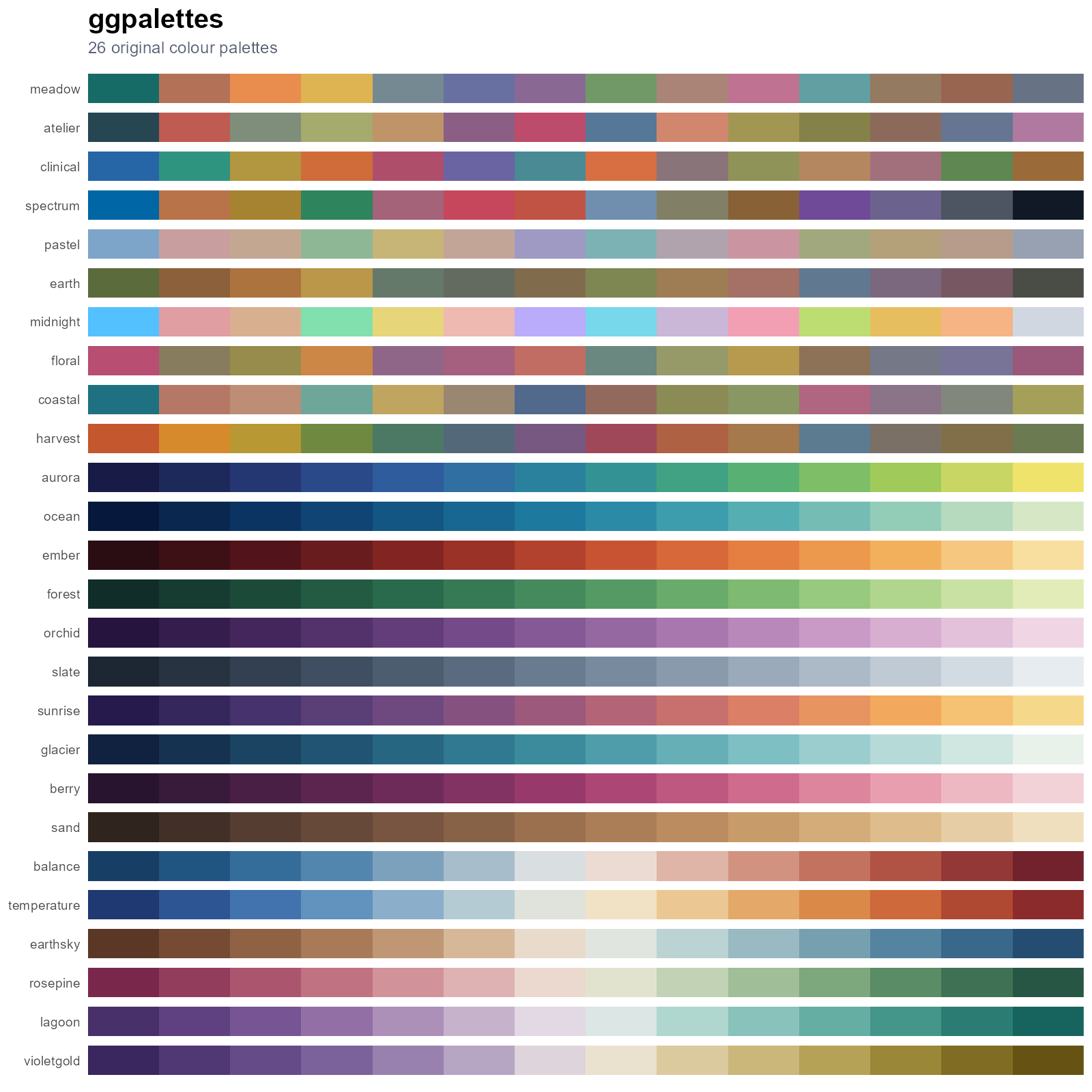
ggpalettes provides 26 original colour palettes and
native colour/fill scales for ggplot2. Its compact
pal_*() and scale_*() interface will feel
familiar to users of scientific palette packages such as
ggsci, while the catalogue focuses on balanced,
publication-ready colours for the ggcraft ecosystem.
# install.packages("pak")
pak::pak("YaoxiangLi/ggpalettes")library(ggpalettes)
library(ggplot2)
gg_palette_names()
gg_palette_info(type = "sequential")
# Palette functions: pal_name()(n)
pal_meadow()(6)
pal_aurora()(12)
ggplot(iris, aes(Sepal.Length, Sepal.Width, colour = Species)) +
geom_point(size = 3) +
scale_colour_clinical() +
theme_minimal()
ggplot(faithfuld, aes(waiting, eruptions, fill = density)) +
geom_raster() +
scale_fill_ember() +
theme_minimal()Every palette has pal_*(), scale_color_*(),
scale_colour_*(), and scale_fill_*() forms.
Generic interfaces are also available:
scale_colour_ggpalette("atelier")
scale_fill_ggpalette("balance")
scale_fill_ggpalette("ocean", binned = TRUE)
Categorical palettes default to discrete scales. Sequential and diverging palettes default to continuous scales, so most plots need no scale-mode argument.
meadow, atelier,
clinical, spectrum, pastel,
earth, midnight, floral,
coastal, and harvest.aurora, ocean,
ember, forest, orchid,
slate, sunrise, glacier,
berry, and sand.balance, temperature,
earthsky, rosepine, lagoon, and
violetgold.Use gg_palette_plot() to draw all or part of the
catalogue. Use gg_palette_check() to screen CIE Lab
separation and contrast against a selected background.
gg_palette_plot(type = "diverging", n = 9)
gg_palette_check("meadow", background = "white")The public API is tested on Windows, macOS, and Linux through
R CMD check.
MIT © Yaoxiang Li